
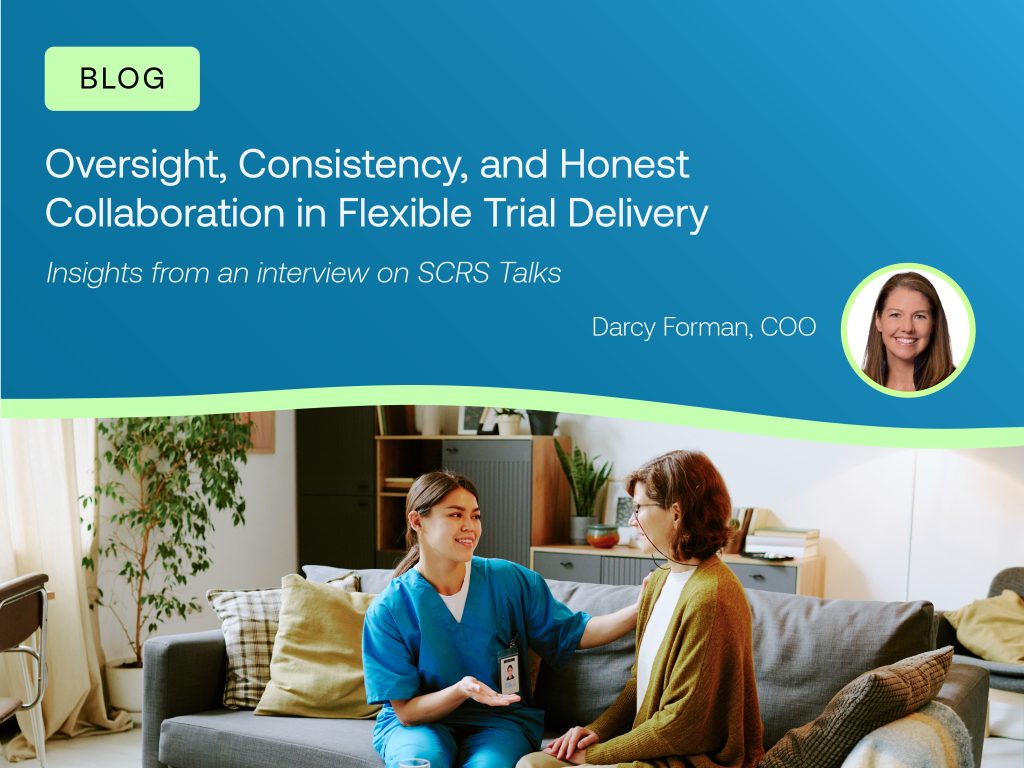
In a recent episode ofSCRS Talks, Lightship COO Darcy Forman sits down with host Jimmy Bechtel to discuss what three decades in clinical research have taught her about flexible trial delivery and where the industry still has room to grow. Darcy traces the lessons the pandemic left behind, the three things that keep investigator oversight intact across settings, and why the sponsor-site relationship is ultimately where flexible models succeed or fail. Read the highlights from Darcy’s conversation below.
Flexibility is a risk-management strategy, but only when it’s intentional.
Darcy opens by describing what sets Lightship apart as a site organization: the ability to match each visit to the setting that best fits the protocol, the assessments, and the participant. Lightship’s network combines brick-and-mortar sites with telemedicine-capable investigators and a mobile research team operating across all 50 states. That combination means a participant can come into the clinic for a complex procedure, have a nurse meet them at home for a routine blood draw, and join a follow-up visit virtually, all within the same study, under the same team.
The pandemic tested this model at speed. When restrictions were lifted, many sponsors reverted to familiar clinic-based workflows. It wasn’t that the underlying challenges of enrollment, access, and representation had been solved; rather, the external pressure requiring change had eased.
There were some issues that also needed to be addressed. Principal investigators (PIs) had been asked to delegate to nurses they didn’t know. Assessments had been moved out of the clinic whether or not the protocol supported it. Regulators were still working out what equivalency looked like across settings. Darcy’s takeaway from this time is pragmatic: “It doesn’t have to be all or nothing.” Lightship’s response is to design for the visit, not the trend. Complex work is kept in the clinic when the protocol demands it, and home or virtual options are offered when it doesn’t.
Strong investigator oversight depends on three things: buy-in, consistency, and connected systems.
One of the questions Darcy gets most often is how Lightship maintains strong investigator oversight when trial activities are happening across clinics, homes, and mobile research environments simultaneously. She breaks it into three requirements.
The first is investigator engagement, which means genuine belief in the framework rather than simple compliance. “If you don’t have investigators believing the model is the right way to deliver trials, it’s not going to work.” Every investigator in Lightship’s network, across its 15 physical sites and 50-state virtual licensure, has to be 100% committed to the mission.
The second is process consistency, and this is where Darcy is most emphatic. Every visit, regardless of setting, should meet identical standards: SOPs, documentation, execution, oversight. “A visit done in the clinic and a visit done in the home should feel the same,” she says. “It’s just a different location.” When that consistency holds, a home visit carries the same evidentiary weight as a clinic visit.
The third is a shared technology backbone. Centralized eSource and e-consent systems keep investigators connected to what’s happening across environments, so oversight doesn’t depend on proximity. A PI can see what’s happening whether a visit occurs at a site or in a participant’s living room.
Keeping delivery in-house removes a layer of ambiguity that can undermine oversight.
Darcy is candid about a choice Lightship made early: the nurses and coordinators on every Lightship trial are Lightship staff, and investigators operate within Lightship’s network. Delegation flows from a Lightship investigator to a Lightship staff member. There are no external nursing vendors operating under different SOPs, no third parties introducing uncertainty about whether protocols are being followed.
“We took that question mark off the table,” she says. In a framework where visits happen across multiple settings, that single operating system matters. Investigators know the nurses and staff and they trust the delegation. The oversight that’s designed into the model extends from the center to the periphery.
Collaboration is the key that determines whether flexible models actually work.
Darcy closes with what she describes as the longest pole in the tent. Lightship’s commitment to quality is the baseline: 30+ audits with zero critical findings, unified SOPs across every setting, and oversight that travels with the participant regardless of visit location. The standard doesn’t change. Maintaining it, though, requires a willingness for sponsors and sites to have honest, open conversations. Every trial encounters unexpected challenges, and the teams that navigate them best are the ones where sponsors and sites can surface issues quickly and solve them together. “There’s never been a perfect trial,” she says. “What matters is how we identify issues, fix them, and prevent them from happening again.”
When a sponsor creates the conditions for that kind of transparency and both parties can surface what’s going wrong without fear of blame, problems get solved faster and participants are more likely to stay enrolled. When the relationship stays transactional and sites are treated as vendors rather than partners, the friction that builds around inevitable challenges slows everything down. For Darcy, after 30 years in this industry, the quality of that relationship is one of the clearest predictors of how a study will go.
Lightship is a proud Global Impact Partner of SCRS, and Darcy’s conversation with Jimmy Bechtel reflects what that partnership stands for: elevating the site’s voice and keeping the practical realities of trial execution at the center of the conversation.
To learn more about Lightship’s approach or explore a partnership, visit lightship.com or reach out to the team.