
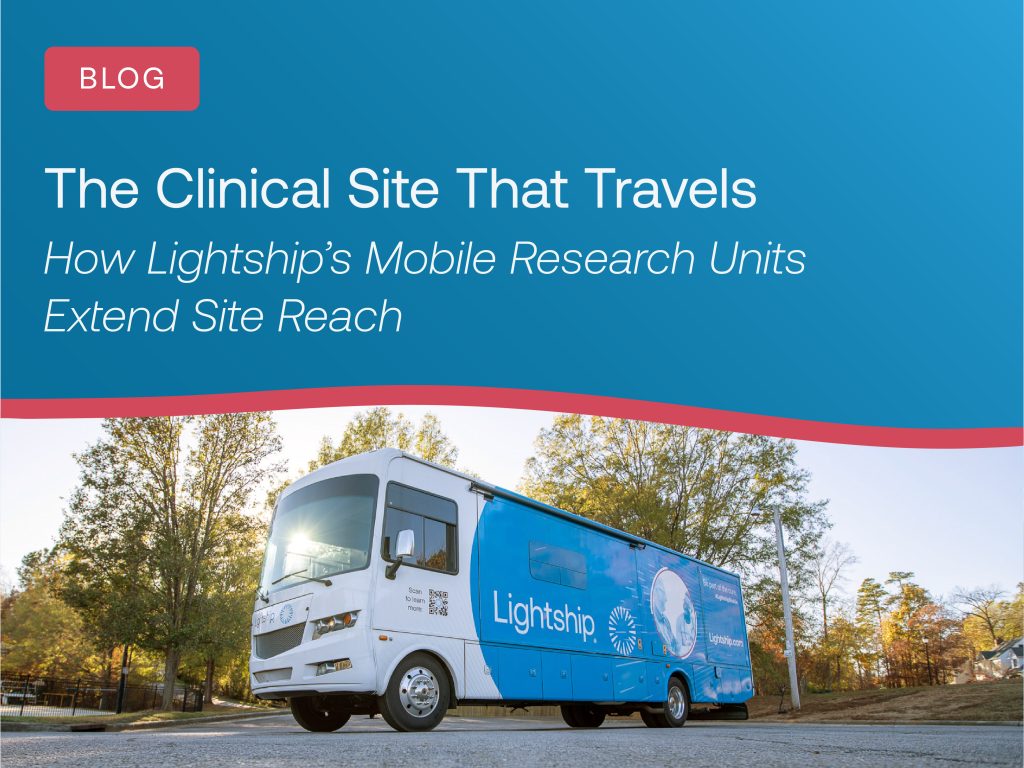
Clinical trials depend on people being able to participate. Yet many studies are still built around fixed locations, which creates real barriers for people who live far from a site, work full-time, are caregivers, or can’t easily rearrange their schedules around clinic hours. When participation isn’t convenient, enrollment slows, representation narrows, and even motivated participants drop out.
Lightship’s Mobile Research Units (MRUs) are built to close that gap. In simple terms, the MRU is a clinic on wheels: a fully equipped clinical unit that travels to communities rather than waiting for participants to come to it. As part of Lightship’s site network, the MRU brings research closer to the people a study needs to reach while maintaining the quality, oversight, and continuity sponsors expect from site-based trial delivery.
For sponsors, the MRU extends the reach of a clinical trial site into communities and geographies a brick-and-mortar site can’t cover on its own.
How are sponsors using the MRU?
The MRU works in three different configurations, each built for a different study need.
Mode 1: Community-Based Health Screenings
The first model brings the MRU directly into communities to deliver health screenings, education, and assessments. The goal is to build trust, share meaningful health information, and create awareness of clinical research as something people can choose to be part of.
Lightship teams build lasting partnerships with local organizations and show up consistently, time after time. At events like Uplift Her Women’s Wellness Day in Houston, Champaign-Urbana Pride Fest, and the Congressional Black Caucus Community Breakfast in Washington, D.C., Lightship offers nurse-led assessments, questionnaires, and point-of-care and lab-based tests, along with information about vaccines and available studies.
For sponsors working to build trials that reflect the participants their therapies will serve, these touchpoints reach communities that clinic-only models systematically miss. The relationships formed here carry forward. With participant consent, structured data capture from these events can also support trial-ready cohort development, giving sponsors a stronger enrollment foundation when a future study begins. Lightship’s participant database now spans approximately 486,000 people across its site network.
Mode 2: National Screening Site
The second model is built for studies where screening volume and geographic reach are the constraints. Lightship operates a centralized National Screening Site that conducts Visit 1 screening at scale across multiple geographies, then refers eligible participants to designated study sites for consent and study visits.
The workflow is straightforward. The MRU runs consent, questionnaires, protocol-aligned clinical testing, and lab sampling under centralized oversight. Medical record acquisition and eligibility confirmation, including lab-based inclusion/exclusion review, happen as part of the same flow. Eligible participants are then handed off to the sites that will carry them through the rest of the trial.
This model is built for studies with high screen-fail rates, programs where sites are capacity-constrained, protocols requiring lab-confirmed eligibility prior to enrollment, and any case where a sponsor wants distributed national screening without adding new site infrastructure.
A study currently in startup shows what this looks like in practice. A CRO partner brought Lightship in as a national screening site for a vaccine trial with a high anticipated screen-fail rate on lab confirmation. The protocol needed to screen a large, geographically distributed population quickly to hit enrollment targets. Lightship was selected to run Visit 1 screening nationally through the MRU, with eligible participants then referred to designated sites for the rest of the trial.
Mode 3: MRU as a Site Extension
The third model uses the MRU as a flexible extension of the Lightship site network. Participants enrolled in a study can complete visits at a traditional clinic site, an MRU location near their community, or at home, where protocol-appropriate. All visits are conducted under PI oversight within the Lightship site structure.
The value is geographic reach without setting up new brick-and-mortar locations, reduced travel burden for participants, and better retention through visit flexibility. For studies where keeping participants engaged is the harder problem, meeting them where they are can make the difference between completing a trial and losing them midway through.
Why the network behind it matters
A mobile unit on its own can raise awareness, collect health information, and connect people with resources. Moving a participant through a clinical trial visit is different work entirely, requiring investigator oversight, unified SOPs, and integration with the study’s existing workflows.
Lightship’s MRU operates inside the site network, staffed by the same investigators, nurses, and coordinators who run study conduct at Lightship’s physical sites. A single SOP framework and quality system govern every visit type, and the same team stays accountable for oversight wherever the visit happens. For the sponsor, that translates to one contract, no reconciliation across parallel processes, and a continuous data record from one setting to the next.
Lightship has completed more than 30 audits with zero critical findings and has engaged with the FDA twice on its hybrid and MRU-based delivery model across the full network and every visit type.
A model built for studies that need broader reach
Sponsors and CROs are navigating familiar pressures: faster enrollment, stronger retention, better representation in study populations, and a process that doesn’t grow more complex with every new capability.
Community-based screenings build relationships with participants and communities that clinic-only models don’t reach. National screening models support a faster path to eligible participants at scale. As a site extension, the MRU reduces the travel burden that causes enrolled participants to drop out, keeping them engaged through the study’s end. And because the MRU operates within Lightship’s coordinated network in all three modes, sponsors add reach without adding a vendor, a contract, or another set of oversight obligations.
Bringing the MRU into study planning early is where the investment pays off most. Protocols designed with the MRU in mind from the start get considerably more from the model than those that treat it as a late addition.
To learn more about how Lightship’s site network can support your next study, visit lightship.com or reach out to the team.
This post is the first in a series on Lightship’s Mobile Research Unit. Future pieces will take a closer look at community health screenings, study-level screening models, and the operational considerations that help determine when and how an MRU adds the most value.